
Getting your head around GDPR compliance doesn’t require a law degree. It requires clarity, structure, and a plan you can actually follow. This GDPR compliance guide walks you through every requirement, every deadline, and every practical step your organisation needs to take — whether you’re a three-person startup or a 300-employee enterprise. No jargon. No fluff. Just the facts that matter.
Key Takeaways
- UK GDPR applies to any organisation processing UK residents’ personal data — regardless of where your business is based.
- The seven core principles (lawfulness, purpose limitation, data minimisation, accuracy, storage limitation, security, and accountability) form the foundation of all compliance activity.
- You must identify a lawful basis before processing any personal data — consent is just one of six options.
- Data subjects have eight enforceable rights, including access, erasure, and objection — and you must respond within one month.
- Non-compliance can cost up to £17.5 million or 4% of global turnover, whichever is higher — plus reputational damage and compensation claims.
- A Data Protection Officer (DPO) is mandatory for public authorities, large-scale monitoring, or special category data processing at scale.
- Data breaches must be reported to the ICO within 72 hours if they pose a risk to individuals’ rights and freedoms.
- Privacy by design and default should be embedded into every new project, system, or process from day one.
- International data transfers require safeguards like International Data Transfer Agreements (IDTAs) or Standard Contractual Clauses (SCCs).
- Regular staff training, audits, and policy reviews are essential to maintaining compliance as your business evolves.
Quick Answer
The UK GDPR is the data protection regulation that governs how organisations collect, use, store, and share personal data about UK residents. To comply, your business must follow seven core principles, establish a lawful basis for every data processing activity, respect eight individual rights, implement robust security measures, and maintain clear documentation including a Record of Processing Activities (ROPA). Non-compliance can result in fines up to £17.5 million or 4% of global turnover. This guide provides a step-by-step roadmap to achieving and maintaining compliance in 2026.
What is the UK GDPR?
The UK General Data Protection Regulation (UK GDPR) is the United Kingdom’s primary data protection law. It sets out how organisations must handle personal data — information that relates to an identified or identifiable living individual. The UK GDPR came into force on 1 January 2021, following Brexit, and works alongside the Data Protection Act 2018 to form the UK’s data protection framework.
At its core, the UK GDPR aims to give individuals control over their personal data while enabling businesses to use data responsibly and transparently. It applies to any organisation that processes UK residents’ data, whether you’re based in London, New York, or Singapore.
For a foundational overview, see our complete guide to what GDPR is.
UK GDPR vs. EU GDPR: Key Differences and Post-Brexit Updates
Post-Brexit, the UK and EU maintain separate but closely aligned data protection regimes. The UK GDPR mirrors the EU GDPR in most respects, but there are important differences. The UK’s Information Commissioner’s Office (ICO) is the supervisory authority, replacing the European Data Protection Board (EDPB) for UK matters. The UK has introduced its own International Data Transfer Agreement (IDTA) to replace EU Standard Contractual Clauses (SCCs) for transfers out of the UK. The UK also has flexibility to diverge from EU rules over time, as seen with the Data (Use and Access) Act 2025, which introduces reforms to consent, research exemptions, and automated decision-making.
If you operate in both jurisdictions, you’ll need to comply with both frameworks. For a detailed comparison, read our guide on EU GDPR vs UK GDPR.
Common mistake: Assuming UK GDPR compliance automatically covers EU GDPR. It doesn’t. If you serve EU customers, you must comply with both.
Who Does the UK GDPR Apply To? (Territorial Scope and Business Size)
The UK GDPR applies to you if:
- Your organisation is established in the UK and processes personal data (even if the processing happens elsewhere).
- You’re not established in the UK but you offer goods or services to UK residents, or you monitor their behaviour (e.g., tracking cookies, online behavioural advertising).
Size doesn’t matter. A sole trader, a charity, a startup, and a multinational corporation are all subject to the same core rules. However, some obligations — like appointing a Data Protection Officer — only apply in specific circumstances.
Decision rule: If you collect email addresses, customer names, employee records, or website analytics tied to individuals in the UK, the UK GDPR applies to you.
For more on which countries fall under GDPR, see our GDPR countries guide. If you’re a US-based business, check out does GDPR affect US companies.
Why GDPR Compliance Matters for Your Business Growth and Trust
GDPR compliance isn’t just about avoiding fines. It’s a competitive advantage. Customers increasingly choose businesses they trust with their data. Compliance demonstrates professionalism, reduces the risk of costly breaches, and opens doors to contracts with larger organisations that require vendor compliance.
Non-compliance, on the other hand, can trigger ICO investigations, enforcement action, compensation claims, and reputational damage that takes years to repair. In 2026, data protection is a board-level issue — not an IT afterthought.
Essential GDPR Definitions You Need to Know
Before you can comply, you need to speak the language. Here are the key terms that underpin the entire UK GDPR framework.
Personal Data vs. Special Category Data
Personal data is any information relating to an identified or identifiable living individual. Names, email addresses, IP addresses, employee records, customer purchase histories — all personal data.
Special category data is a subset of personal data that’s considered more sensitive and receives extra protection. It includes:
- Racial or ethnic origin
- Political opinions
- Religious or philosophical beliefs
- Trade union membership
- Genetic data
- Biometric data (when used for identification)
- Health data
- Sex life or sexual orientation
Processing special category data requires a lawful basis under Article 6 and a separate condition under Article 9 of the UK GDPR. The bar is higher. The risks are greater.
Data Controller vs. Data Processor
A data controller determines the purposes and means of processing personal data. You decide why and how the data is used. Most businesses are controllers for their customer and employee data.
A data processor processes personal data on behalf of a controller. Think payroll providers, cloud hosting services, email marketing platforms. Processors act on the controller’s instructions.
Why it matters: Controllers carry the primary compliance burden. Processors have their own obligations and must sign a Data Processing Agreement (DPA) with the controller.
Example: If you use Mailchimp to send newsletters, you’re the controller. Mailchimp is the processor.
The Data Subject
A data subject is the individual to whom personal data relates. Your customers, employees, website visitors, and newsletter subscribers are all data subjects. They hold enforceable rights under the UK GDPR — and you must respect them.
Data Processing and Profiling
Processing means almost any operation performed on personal data: collection, storage, use, sharing, deletion. Even just holding data counts as processing.
Profiling is automated processing used to evaluate, analyse, or predict aspects of an individual’s behaviour, preferences, or characteristics. It’s commonly used in marketing, credit scoring, and recruitment — and it triggers additional transparency and fairness obligations.

The 7 Core Principles of the UK GDPR
The UK GDPR is built on seven foundational principles. Every processing activity must comply with all seven. They’re not optional. They’re not aspirational. They’re the law.
Lawfulness, Fairness, and Transparency
You must process personal data lawfully (with a valid lawful basis), fairly (without deception or adverse impact), and transparently (individuals must know what you’re doing with their data). This principle underpins everything else.
Practical application: Your privacy notice must be clear, accessible, and written in plain English — not buried in legalese.
Purpose Limitation
You can only collect personal data for specified, explicit, and legitimate purposes — and you can’t use it for anything incompatible with those purposes later. If you collect email addresses for order confirmations, you can’t suddenly start sending marketing emails without consent.
Common mistake: Repurposing data collected for one reason (e.g., recruitment) for another (e.g., marketing) without a fresh lawful basis.
Data Minimisation
Collect only the data you actually need. No more. If you don’t need a customer’s date of birth to fulfil an order, don’t ask for it. Less data means less risk.
Accuracy
Personal data must be accurate and kept up to date. You must take reasonable steps to correct or delete inaccurate data. This is especially important for employee records, credit files, and customer accounts.
Storage Limitation
Don’t keep personal data longer than necessary. Define retention periods for different data types and delete or anonymise data once the purpose has been fulfilled. Your retention schedule should be documented and followed.
Example: If you retain job applications for six months, delete them after that period unless there’s a legal or contractual reason to keep them longer.
Integrity and Confidentiality (Data Security)
You must protect personal data against unauthorised or unlawful processing, accidental loss, destruction, or damage. This means implementing appropriate technical and organisational measures: encryption, access controls, staff training, secure backups, and incident response plans.
Accountability and Governance
You must demonstrate compliance. This means maintaining records, conducting audits, documenting decisions, training staff, and implementing policies. If the ICO asks, you need to prove you’ve done the work.
The 6 Lawful Bases for Processing Personal Data
Before you process any personal data, you must identify a lawful basis under Article 6 of the UK GDPR. There are six options. Choose the one that best fits your processing activity — and document your decision.
Consent (and the Strict Rules Around It)
Consent means the individual has given clear, informed, and freely given permission for you to process their data for a specific purpose. Consent must be:
- Freely given (no coercion or imbalance of power)
- Specific (tied to a particular purpose)
- Informed (the individual knows what they’re consenting to)
- Unambiguous (clear affirmative action, not pre-ticked boxes)
- Withdrawable (easy to withdraw at any time)
Consent is often the hardest lawful basis to rely on — and it’s rarely the best choice for B2B or employment contexts.
Decision rule: Use consent for marketing emails, cookies, and optional data collection. Don’t rely on consent for core business functions like payroll or contract fulfilment.
Contractual Obligation
You can process personal data if it’s necessary to perform a contract with the individual, or to take steps at their request before entering into a contract. This is the most common lawful basis for customer data.
Example: Processing a customer’s name and delivery address to fulfil an online order.
Legal Obligation
You can process personal data if it’s necessary to comply with a legal obligation (other than a contractual one). This covers tax records, employment law requirements, and regulatory reporting.
Example: Retaining employee payroll records for HMRC.
Vital Interests
You can process personal data if it’s necessary to protect someone’s life. This is a narrow basis, typically used in emergency medical situations.
Public Task
You can process personal data if it’s necessary to perform a task in the public interest or in the exercise of official authority. This applies mainly to public authorities and certain regulated sectors.
Legitimate Interests (and Recognised Legitimate Interests)
You can process personal data if it’s necessary for your legitimate interests (or those of a third party), unless those interests are overridden by the individual’s rights and freedoms. This is the most flexible lawful basis — but it requires a Legitimate Interests Assessment (LIA) to balance your interests against the individual’s.
The Data (Use and Access) Act 2025 introduced a list of Recognised Legitimate Interests (RLIs) where the balancing test is deemed satisfied, including fraud prevention, network security, and direct marketing to existing customers.
Common mistake: Assuming legitimate interests is a catch-all. It’s not. You must document your assessment and be prepared to justify it.
The 8 Data Subject Rights Explained
Individuals have eight enforceable rights under the UK GDPR. You must respond to requests within one month (extendable by two months in complex cases). Failure to respond can result in ICO complaints and enforcement action.
1. The Right to Be Informed
Individuals have the right to know how you’re using their personal data. This is why you need a clear, accessible privacy notice that covers:
- Your identity and contact details
- The purposes of processing
- The lawful basis
- Who you share data with
- Retention periods
- Data subject rights
- Whether you transfer data internationally
2. The Right of Access (Managing Data Subject Access Requests – DSARs)
Individuals can request a copy of the personal data you hold about them. This is called a Data Subject Access Request (DSAR). You must provide the information free of charge within one month, along with details of how you’re using it.
Common mistake: Failing to search all systems (email, cloud storage, backups) when responding to a DSAR.
3. The Right to Rectification
Individuals can ask you to correct inaccurate or incomplete personal data. You must comply within one month and notify any third parties you’ve shared the data with.
4. The Right to Erasure (The Right to Be Forgotten)
Individuals can request deletion of their personal data in certain circumstances:
- The data is no longer needed for the original purpose
- They withdraw consent (and there’s no other lawful basis)
- They object to processing (and there’s no overriding legitimate interest)
- The data was unlawfully processed
- Deletion is required by law
Edge case: You can refuse erasure if you have a legal obligation to retain the data (e.g., tax records) or if it’s needed for legal claims.
5. The Right to Restrict Processing
Individuals can ask you to stop processing their data (but continue storing it) in certain situations, such as while you verify accuracy or assess a deletion request.
6. The Right to Data Portability
Individuals can request their personal data in a structured, commonly used, machine-readable format (e.g., CSV, JSON) — and ask you to transfer it to another organisation. This right only applies when processing is based on consent or contract, and the processing is automated.
7. The Right to Object
Individuals can object to processing based on legitimate interests, public task, or direct marketing. For direct marketing, you must stop immediately. For other objections, you must stop unless you can demonstrate compelling legitimate grounds that override the individual’s interests.
8. Rights Related to Automated Decision-Making and Profiling
Individuals have the right not to be subject to decisions based solely on automated processing (including profiling) that produce legal or similarly significant effects — unless the decision is necessary for a contract, authorised by law, or based on explicit consent. When automated decisions are made, you must provide meaningful information about the logic involved and the consequences.
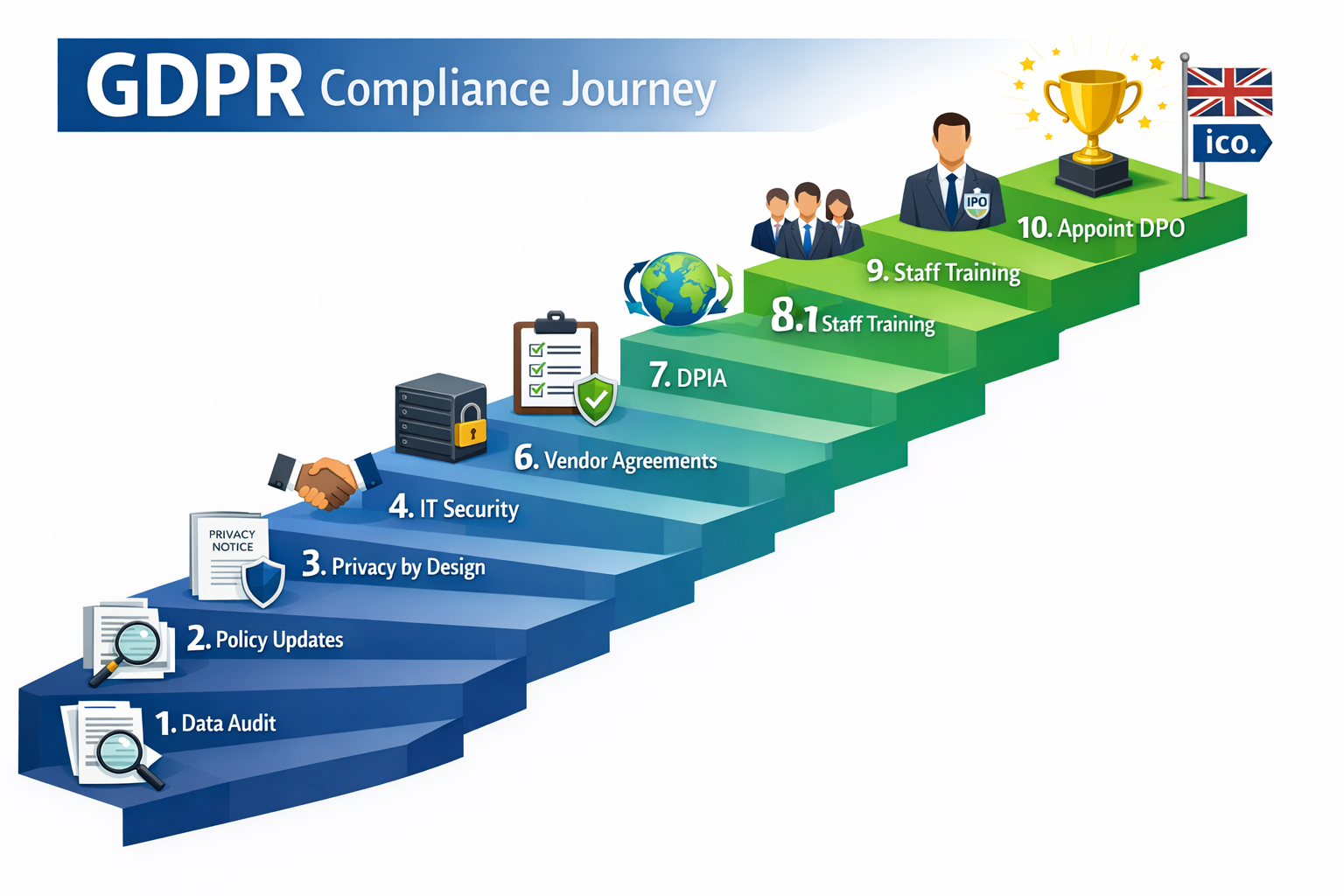
Your Step-by-Step GDPR Compliance Checklist
This GDPR compliance guide breaks down the journey into ten actionable steps. Follow them in order, document your progress, and you’ll build a robust compliance framework.
Step 1: Conduct a Data Audit and Map Your Data (ROPA)
Start by identifying what personal data you hold, where it came from, who you share it with, and where it’s stored. Create a Record of Processing Activities (ROPA) — a living document that maps every data flow in your organisation.
What to include:
- Categories of personal data
- Purposes of processing
- Lawful basis for each purpose
- Data sources
- Recipients (internal and external)
- Retention periods
- Security measures
For detailed guidance, see our GDPR compliance audit guide.
Step 2: Update Privacy Notices and Cookie Policies
Your privacy notice must be clear, concise, and accessible. Review it against the ICO’s guidance and update it to reflect your current processing activities. If you use cookies or tracking technologies, you need a separate cookie policy and a compliant consent mechanism.
Common mistake: Using generic privacy notice templates that don’t reflect your actual data practices.
Step 3: Implement Privacy by Design and Default
Privacy by design means embedding data protection into every new project, system, or process from the outset. Privacy by default means ensuring that, by default, only the minimum necessary personal data is processed.
Practical steps:
- Conduct Data Protection Impact Assessments (DPIAs) for high-risk processing
- Limit access to personal data on a need-to-know basis
- Pseudonymise or anonymise data where possible
- Build privacy settings into new systems
Step 4: Secure Your IT Systems, Devices, and Networks
Technical security is non-negotiable. Implement:
- Encryption for data at rest and in transit
- Strong passwords and multi-factor authentication (MFA)
- Access controls based on roles and responsibilities
- Regular software updates and patching
- Secure backups stored separately from live systems
- Endpoint protection (antivirus, firewalls)
For remote teams, see our guide on security risks of remote working. Consider Cyber Essentials certification as a baseline.
Step 5: Review and Manage Third-Party Vendor Agreements (DPAs)
Every processor you use must sign a Data Processing Agreement (DPA) that sets out their obligations, security measures, and your rights as controller. Review your existing contracts and ensure DPAs are in place with cloud providers, payroll services, marketing platforms, and any other third party that processes personal data on your behalf.
Step 6: Create a Data Breach Response and 72-Hour Reporting Plan
You must report certain data breaches to the ICO within 72 hours of becoming aware of them. Develop a breach response plan that includes:
- Identification and containment procedures
- Assessment of risk to individuals
- Notification protocols (ICO and affected individuals)
- Roles and responsibilities
- Post-incident review and remediation
Decision rule: If a breach is likely to result in a risk to individuals’ rights and freedoms, report it. If in doubt, report it.
Step 7: Conduct Data Protection Impact Assessments (DPIAs)
A DPIA is a structured process for identifying and mitigating privacy risks in high-risk processing activities. You must conduct a DPIA when:
- Using new technologies
- Processing special category data at scale
- Systematic monitoring of public areas (e.g., CCTV)
- Automated decision-making with legal or significant effects
- Processing children’s data at scale
DPIAs should be conducted before you start processing.
Step 8: Ensure Safe International Data Transfers (IDTAs & SCCs)
If you transfer personal data outside the UK, you must ensure adequate protection. The UK recognises certain countries as providing adequate protection (including the EU, EEA, and others). For transfers to non-adequate countries, you must use:
- International Data Transfer Agreements (IDTAs) (the UK’s version of SCCs)
- Standard Contractual Clauses (SCCs) (EU version, if transferring from the EU)
- Binding Corporate Rules (BCRs) (for intra-group transfers)
Common mistake: Assuming US-based cloud providers are automatically compliant. Check their data transfer mechanisms.
Step 9: Train Your Staff and Build a Culture of Compliance
Compliance isn’t just a policy document. It’s a culture. Every employee who handles personal data must understand their responsibilities. Provide regular training on:
- The basics of UK GDPR
- Your organisation’s policies and procedures
- How to recognise and report data breaches
- How to handle data subject requests
For structured training, explore our GDPR training for employees. The ICO recommends refresher training at least annually — see how often should GDPR training be done.
Step 10: Determine If You Need a Data Protection Officer (DPO)
You must appoint a Data Protection Officer (DPO) if:
- You’re a public authority
- Your core activities involve large-scale systematic monitoring of individuals (e.g., behavioural advertising, tracking)
- Your core activities involve large-scale processing of special category data or criminal conviction data
If you don’t meet these criteria, you’re not legally required to appoint a DPO — but you may still benefit from designating a data protection lead or using an outsourced DPO service.
For more detail, read our guide on what is a Data Protection Officer.
Sector-Specific GDPR Compliance Challenges
Different sectors face different data protection challenges. Here’s what you need to know.
GDPR for SMEs and Startups
Small businesses often lack dedicated compliance teams. The good news? Proportionality matters. Your compliance measures should reflect the scale, complexity, and risk of your processing. Start with the basics: privacy notice, ROPA, staff training, and secure systems. For cost guidance, see how much does GDPR compliance cost.
GDPR for Financial Services
Financial services firms handle sensitive financial data, conduct credit checks, and are subject to additional regulatory obligations (FCA, PRA). You’ll need robust consent mechanisms, clear privacy notices, and strong security controls. Anti-money laundering (AML) and fraud prevention are recognised legitimate interests — but you still need to document your assessments.
GDPR for E-Commerce, Retail, and Marketing
E-commerce and marketing teams rely heavily on customer data for personalisation, targeting, and analytics. Key challenges include:
- Cookie consent and tracking
- Email marketing (consent vs. legitimate interests)
- Profiling and automated decision-making
- Third-party data sharing (ad platforms, analytics)
Decision rule: For B2C marketing emails, use consent. For B2B emails to corporate addresses, you may rely on legitimate interests — but document your LIA.
GDPR for Clubs, Societies, and Non-Profits
Charities and membership organisations often process data from volunteers, donors, and members. You still need a lawful basis, a privacy notice, and appropriate security. Consent is common for fundraising communications, but legitimate interests may apply for member administration.
Modern Data Challenges: AI, Remote Work, and Future-Proofing
Data protection doesn’t stand still. Here’s how to stay ahead.
Artificial intelligence and machine learning raise complex GDPR issues: automated decision-making, profiling, transparency, and bias. If you use AI to make decisions that affect individuals (e.g., recruitment, credit scoring, pricing), you must:
- Provide meaningful information about the logic involved
- Ensure human oversight and intervention where appropriate
- Conduct DPIAs for high-risk AI systems
- Monitor for bias and discrimination
The Data (Use and Access) Act 2025 introduced reforms to automated decision-making rules — stay updated on ICO guidance.
Remote Work: Keeping Home Offices and Distributed Teams Compliant
Remote work introduces new risks: unsecured home networks, shared devices, phishing attacks, and physical document security. Mitigate these with:
- VPNs for remote access
- Encrypted devices and cloud storage
- Clear remote working policies
- Regular security awareness training
- Secure disposal of physical documents
For more, see our security risks of remote working guide.
Adapting to the Data (Use and Access) Act and Regulatory Shifts
The Data (Use and Access) Act 2025 (DUAA) introduced targeted reforms to the UK GDPR framework, including changes to consent, research exemptions, and recognised legitimate interests. Stay informed by monitoring ICO updates and reviewing your compliance documentation regularly. For a full breakdown, read our guide to the Data Use and Access Act 2025.
The Consequences of Non-Compliance
Non-compliance isn’t a theoretical risk. It’s a real, measurable threat.
ICO Fines, Tiered Penalties, and Enforcement Action
The ICO can issue fines up to:
- £8.7 million or 2% of global annual turnover (whichever is higher) for breaches of processing principles, security obligations, or processor duties.
- £17.5 million or 4% of global annual turnover (whichever is higher) for breaches of core principles, lawful basis requirements, or data subject rights.
The ICO also issues enforcement notices, reprimands, and orders to suspend data processing. For real-world examples, see our GDPR fines and penalties guide.
Compensation Claims and Reputational Damage
Individuals can bring compensation claims for material or non-material damage caused by GDPR breaches. Class actions are becoming more common. Beyond financial penalties, non-compliance damages trust, customer loyalty, and brand reputation — often irreparably.
How Our GDPR Consultancy Firm Can Help Protect Your Business
Achieving compliance is complex. Maintaining it is harder. That’s where we come in.
Comprehensive GDPR Audits and Gap Analysis
We conduct thorough GDPR compliance audits and gap analyses to identify risks, document your current state, and create a prioritised action plan.
Outsourced Data Protection Officer (vDPO) Services
Don’t need a full-time DPO? Our outsourced DPO services provide expert oversight, ICO liaison, and strategic guidance — without the overhead of a permanent hire.
Custom Data Protection Frameworks and Policy Drafting
We draft tailored privacy notices, data processing agreements, retention schedules, and internal policies that reflect your actual operations — not generic templates. Access our GDPR document templates or commission bespoke policies.
Bespoke Employee GDPR Training Programs
We deliver engaging, role-specific GDPR training and cyber security awareness training that sticks. Your team will understand not just what to do, but why it matters.
On-Demand Breach Management and ICO Remediation Support
When a breach happens, every minute counts. We provide rapid response support, breach investigation, ICO notification, and remediation planning to minimise harm and regulatory exposure.
Ready to get started? Contact us or explore our resources library for free tools and templates.
Frequently Asked Questions (FAQs) About GDPR Compliance
Yes. If you use non-essential cookies (analytics, marketing, tracking), you must obtain informed consent before placing them on a user’s device. Cookie banners remain the standard mechanism for obtaining that consent. Pre-ticked boxes and implied consent don’t meet the UK GDPR standard.
What qualifies as a reportable data breach to the ICO?
A breach is reportable if it’s likely to result in a risk to individuals’ rights and freedoms. This includes breaches involving special category data, large-scale exposure of personal data, or breaches that could lead to identity theft, financial loss, or reputational damage. If in doubt, report it within 72 hours.
Can B2B marketing emails be sent without explicit consent?
Yes, in certain circumstances. If you’re sending marketing to a corporate email address (not a personal one) and you have a legitimate interest in promoting your services, you may rely on the legitimate interests lawful basis — provided you conduct and document a Legitimate Interests Assessment (LIA) and offer an easy opt-out. For personal email addresses, consent is safer.
How long can a business legally retain personal data?
There’s no single answer. Retention periods depend on the purpose of processing, legal obligations (e.g., tax records must be kept for six years), and sector-specific rules. Document your retention schedule and delete or anonymise data once the purpose has been fulfilled and legal obligations have been met.
Do I need a DPO if I’m a small business?
Not necessarily. You only need a DPO if you’re a public authority, conduct large-scale systematic monitoring, or process special category data at scale. Many small businesses don’t meet these criteria — but appointing a data protection lead or using an outsourced DPO can still be valuable.
What happens if I ignore a Data Subject Access Request (DSAR)?
Ignoring a DSAR is a breach of the UK GDPR. The individual can complain to the ICO, which can investigate and issue enforcement action. You must respond within one month (extendable by two months in complex cases) and provide the requested information free of charge.
Can I transfer personal data to the US post-Brexit?
Yes, but you must ensure adequate safeguards. The UK recognises certain US organisations under the UK Extension to the EU-US Data Privacy Framework. For other transfers, use International Data Transfer Agreements (IDTAs) or Standard Contractual Clauses (SCCs). Always check the current ICO guidance.
What’s the difference between a data controller and a data processor?
A data controller determines the purposes and means of processing. A data processor processes data on behalf of the controller. Controllers have primary compliance responsibility. Processors must follow the controller’s instructions and sign a Data Processing Agreement (DPA).
Is GDPR compliance a one-time project?
No. GDPR compliance is an ongoing process. You must review and update policies, conduct regular audits, train staff, monitor third-party processors, and respond to regulatory changes. Compliance is a journey, not a destination.
How do I know if I need to conduct a Data Protection Impact Assessment (DPIA)?
Conduct a DPIA when processing is likely to result in a high risk to individuals’ rights and freedoms. This includes large-scale processing of special category data, systematic monitoring, automated decision-making with legal effects, and use of new technologies. The ICO provides a screening checklist.
Can I use legitimate interests for employee data?
Yes, but with caution. Legitimate interests can apply to employee data (e.g., payroll, performance management), but you must conduct a Legitimate Interests Assessment (LIA) and consider the power imbalance inherent in the employment relationship. For sensitive processing, consent or legal obligation may be more appropriate.
What should I do if I discover a data breach?
Contain the breach immediately, assess the risk to individuals, document the incident, and report to the ICO within 72 hours if required. Notify affected individuals if the breach is likely to result in a high risk to their rights and freedoms. Conduct a post-incident review and implement remediation measures.
Conclusion
GDPR compliance isn’t optional. It’s not a tick-box exercise. And it’s not something you can outsource entirely and forget. But with the right approach, it’s entirely achievable — even for small teams with limited resources.
This GDPR compliance guide has walked you through the foundations: the seven principles, the six lawful bases, the eight data subject rights, and the ten practical steps to build a compliant, secure, and accountable data protection framework. You now know what the UK GDPR requires, why it matters, and how to get started.
Your next steps:
- Conduct a data audit and create your Record of Processing Activities (ROPA).
- Review and update your privacy notice to reflect your current processing.
- Identify and document your lawful bases for every processing activity.
- Implement technical security measures (encryption, access controls, MFA).
- Train your team and embed a culture of compliance.
- Consider professional support — whether that’s a gap analysis, outsourced DPO services, or bespoke training.
Compliance is a journey. Start today. Stay vigilant. And remember: protecting personal data isn’t just about avoiding fines — it’s about building trust, safeguarding your reputation, and doing right by the people whose data you hold.
Need expert guidance? Get in touch or download our Complete Guide to UK GDPR eBook for deeper insights.